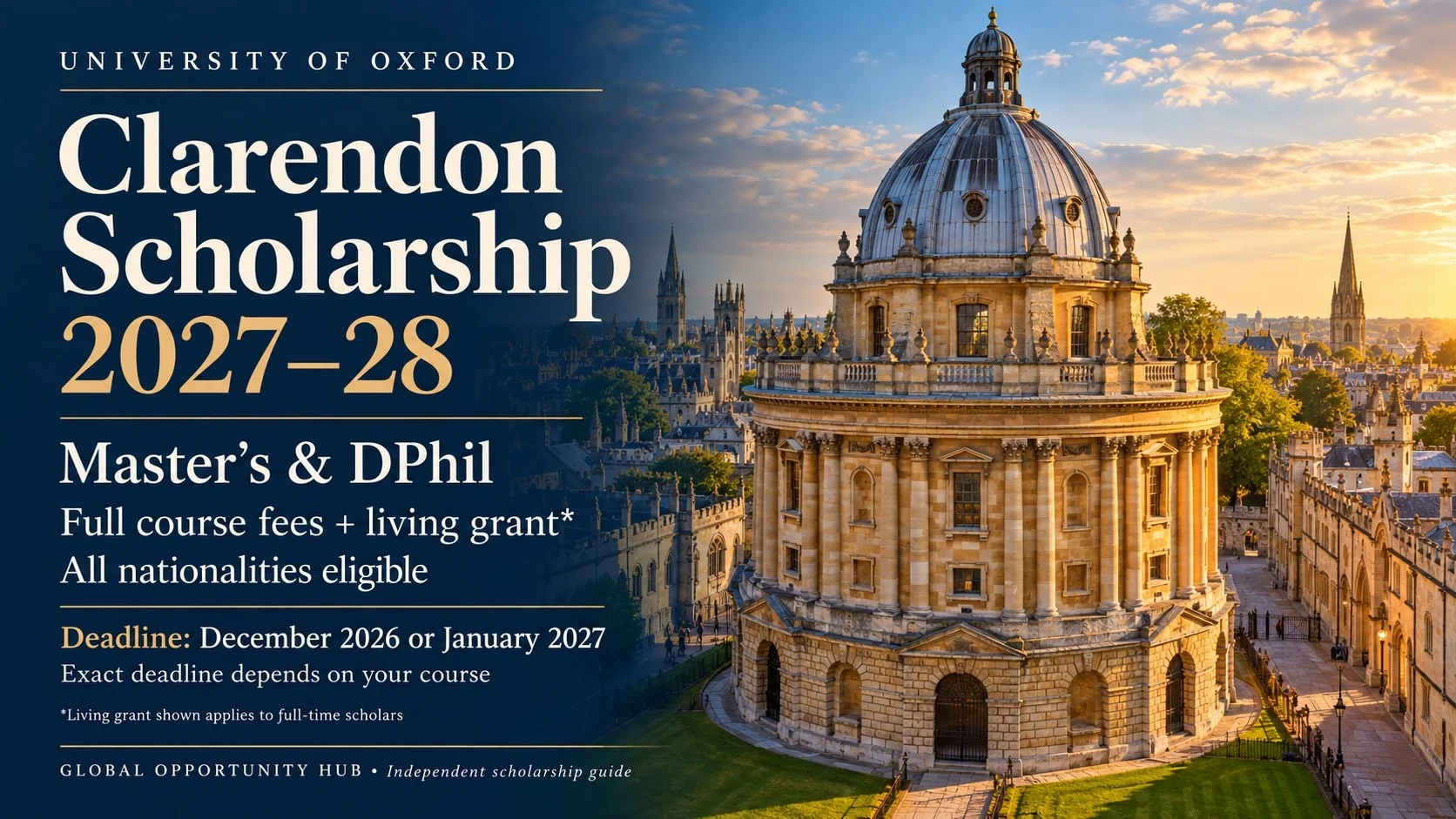
Oxford Clarendon Scholarship 2027: Funding and Application Guide for African Students
An Oxford scholarship application can begin with something less complicated than many applicants expect: applying for the right postgraduate course. For the Clarendon Scholarship, there is no separate scholarship form. Your course application is also your opportunity to be considered for funding, provided you submit it by the relevant funding deadline. For Nigerian and other African graduates considering postgraduate study abroad, this creates a practical route worth exploring. However, the details matter: choosing the wrong deadline, overlooking an application fee or submitting a generic statement can weaken an otherwise promising application. Here is how the opportunity works and how to prepare thoughtfully. Information checked against official Oxford sources on 8 October 2026.
What is the Clarendon Scholarship?
Clarendon is a graduate scholarship programme at the University of Oxford in the United Kingdom. It supports students pursuing master’s and DPhil degrees; DPhil is Oxford’s name for its doctoral degree. The programme has no restrictions based on nationality or ordinary residence, and it covers a broad range of academic subjects. Selection focuses on academic excellence and potential. Applicants who submit their eligible course application by its relevant December or January deadline receive automatic consideration. Automatic consideration does not mean automatic selection. Oxford’s Clarendon overview.
What does the funding cover?
For full time scholars, Clarendon covers course fees and provides an annual living grant. Oxford links that grant to at least the UKRI minimum doctoral stipend rate. Funding normally follows the course’s period of fee liability, the period during which the university charges course fees. Part time awards have different study support arrangements. Check the exact amount and duration in your award letter. Do not use a stipend figure from an older scholarship article as a confirmed amount for 2027–28. Official funding details. For planning purposes, keep a separate budget for expenses that may arise before funding starts: transcripts, tests, application charges and travel preparations. Do not assume flights, immigration costs or family expenses are separately funded unless your award documentation confirms this.
Applications are open—but there is no single deadline
Oxford’s course pages show whether applications are open and which deadlines apply. For example, the MSc in Statistical Science was open when checked. It lists an earlier deadline of 13 November 2026 and a final deadline of 27 January 2027, both at 12 noon UK time. Its funding section directs applicants to apply by the January deadline for scholarship consideration. These dates apply to that course, not every Oxford programme. Official MSc course page. This distinction matters. A course may accept later applications after the main scholarship deadline has passed. Record your chosen course’s funding deadline, required documents and reference requirements together. Oxford recommends submitting at least two weeks early, giving you time to address missing items. Oxford’s deadline guidance.
What African applicants should know about qualifications
Start with the requirements for your particular course, then compare your qualification with Oxford’s country guidance. For Nigerian qualifications, Oxford’s general guidance says a course requiring a strong UK upper second-class degree will usually expect a recognised bachelor’s degree with a 2:1, 65%, or GPA of 4.0 out of 5.0. Where a UK first class degree is required, the guidance normally indicates first class honours, 70%, or GPA of 4.5 out of 5.0. These are general equivalencies, not a universal Clarendon cut off. Course requirements and scholarship competitiveness still matter. Applicants from other African countries should consult their own country’s guidance rather than copy Nigeria’s figures. Oxford’s international qualification guidance. Keep the grading system shown on your actual documents. Oxford says applicants with non-UK qualifications do not need to convert them into UK classifications when entering their qualifications. Qualification-entry instructions.
The application costs worth checking early
There is no separate Clarendon application, but applying for an Oxford course normally involves a fee:
- £75 for a taught-course application
- £20 for a research-course application Check how Oxford classifies your chosen programme before budgeting. Official application fees. Fee waivers exist, but African nationality alone does not establish eligibility. Oxford’s low-income-country scheme considers ordinary residence, financial need and whether the applicant meets the course’s entry requirements. Nigeria is not on the current country list for that particular scheme. Other waiver categories, including provisions for refugees and displaced applicants, have their own criteria. Check the official rules before paying or assuming that a waiver is available. Application fee waiver guidance.
Do you need IELTS before applying?
Oxford allows applicants to submit a graduate application before providing English language test results. An eventual offer may still require acceptable results before enrolment. An English-taught degree can sometimes support a waiver request, but approval is not automatic. Oxford specifies conditions concerning the institution, language of teaching and assessment, study duration and recency. Before booking any test, check the accepted tests and required scores for your course. This is especially useful when application costs are already stretching your budget. Oxford’s English language requirements.
How to build an application that explains your strengths
Before writing, match each course requirement with a real example from your background. Organise your notes around these three areas:
- Relevant subject knowledge Identify the modules, grades or academic projects that demonstrate your preparation for the course. Your transcript provides the academic record; your statement can explain how your most relevant studies prepared you for further learning.
- Research preparation If you completed a dissertation or research project, note the question you investigated, the methods you used and what you found. Where the course requires a research proposal or written work, use suitable evidence to demonstrate your research skills while following its specific instructions.
- Motivation for further study Identify a question or professional problem you want to understand better. In your statement of purpose, explain how the course would help you investigate it and develop the knowledge you currently lack. These notes are a personal preparation tool, not an additional document Oxford requires. Use them to make your application specific, accurate and supported by evidence.
This is a preparation tool, not an extra document Oxford requires. The exercise helps you replace broad statements with useful evidence. Instead of saying you are passionate about public health, identify a question you encountered, what you did to investigate it and what you still need to learn. If your experience comes from a local university, community organisation or small employer, give enough context for an unfamiliar reader to understand it. Explain your contribution accurately. Avoid inflating a team achievement into something you completed alone. Then connect that experience to the course. Identify relevant teaching, research or methods rather than relying on Oxford’s reputation as your main reason for applying.
Prepare your documents and referees before the deadline
Use the document list on your course page. Requirements differ, so a statement, CV or research proposal prepared for another university may need substantial reconsideration. Ask potential referees early and give them your course details, deadline and a brief reminder of work they supervised. Choose people who can explain your abilities with concrete examples. Submitting the application form is not the whole process. Oxford normally requires the mandatory supporting documents and at least two submitted references by the deadline for consideration; check any additional requirements for your course. Complete-application requirements. Your own internal deadline should leave room for delayed transcripts, unavailable referees or an upload problem.
Keep your application in your own voice
Templates can help you organise a checklist, but your academic arguments and personal explanation must be your own. Oxford permits limited AI assistance, including formatting, spelling and grammar checks. It does not permit asking AI to write your personal statement or research proposal for you. Its guidance also explains how to acknowledge permitted research assistance. Oxford’s application AI policy. A useful self-check is whether you could discuss every claim, research idea and example in an interview without relying on a prepared script.
Admission, funding and permission to travel are different
An admission offer should not be treated as a scholarship award. Wait for written funding confirmation before making commitments that depend on that money. Scholarship eligibility also does not settle immigration eligibility. Oxford currently highlights student-visa restrictions affecting certain nationalities, including Cameroon and Sudan. Applicants who may be affected should follow Oxford’s linked official guidance before incurring application costs. Oxford’s current applicant notice.
A final check: is this opportunity suitable for you?
Before applying, ask yourself:
- Does my qualification meet the requirements of the specific course?
- Can I explain why its academic content fits my next step?
- Do I have evidence of strong academic work and potential?
- Can my documents and references reach Oxford before the funding deadline?
- Have I checked application costs and any available waiver?
- Do I understand the language requirements and any travel restrictions affecting me? If those answers are encouraging, approach the application seriously. Your experience does not need to sound impressive through exaggerated language; it needs to be clear, relevant and supported by evidence. Clarendon is competitive, but careful preparation allows you to put forward a more coherent account of what you can contribute.
Apply independently—-- or ask us for guidance
You can apply directly through Oxford’s official website. Begin with the graduate course directory, choose your programme and follow its application instructions. If you need help understanding eligibility, organising your documents or planning your submission, Global Opportunity Hub, can help you work through the requirements. Use the “Let us apply for you” button to discuss the assistance you need. For this opportunity, support should respect Oxford’s authorship rules: your statements, research ideas and academic work must remain your own. Our assistance is optional and independent of the University of Oxford.
Verified by Global Admissions Experts
This opportunity has been manually reviewed for accuracy. A Vixx Integrated Services initiative.
Explore Alternative Routes
Share this opportunity
Join the VIP Alert List
Do not miss the next fully-funded opportunity. Get high-value scholarships and visa sponsorship routes sent directly to your phone.