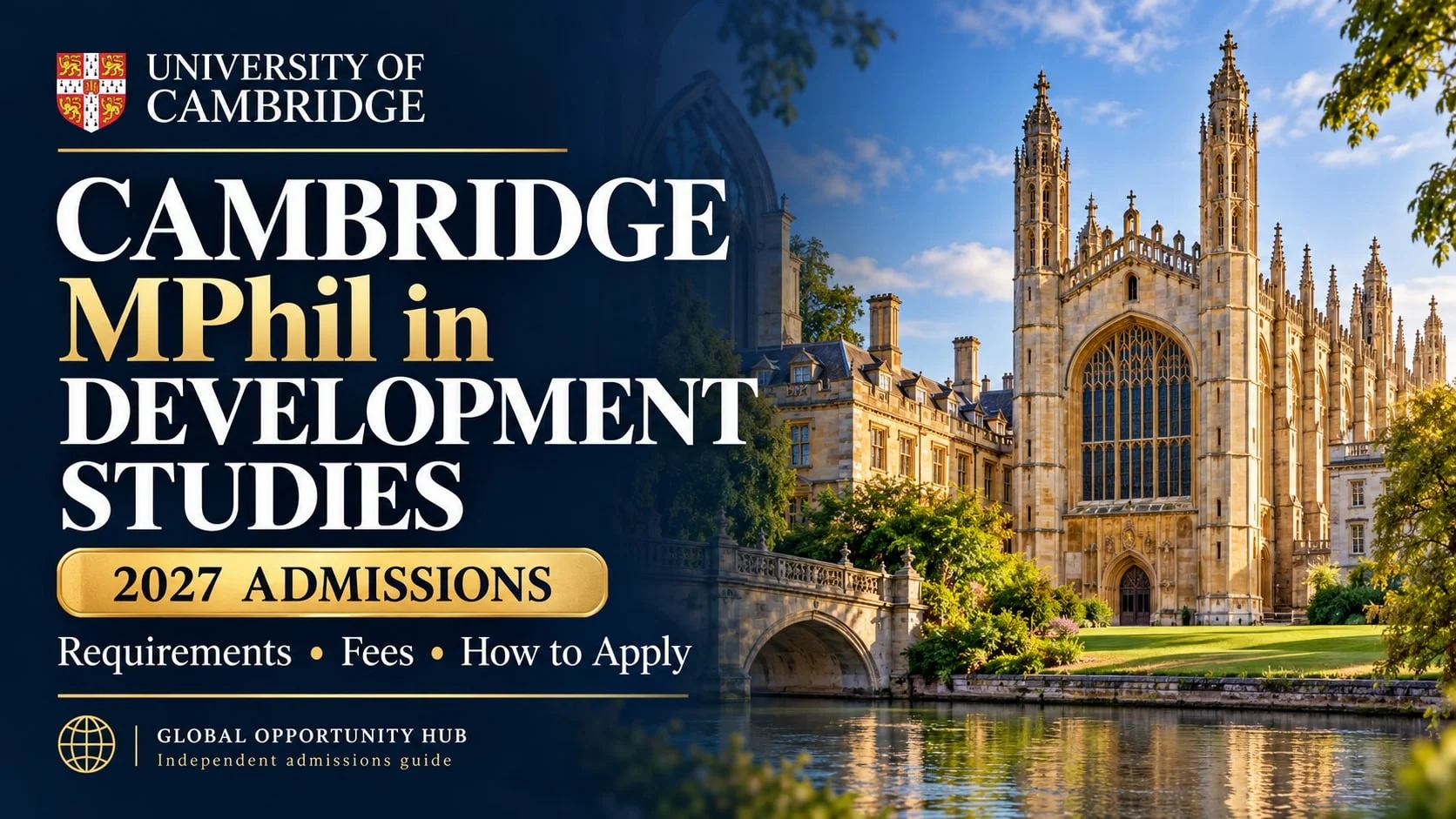
The University of Cambridge is accepting applications for its MPhil in Development Studies, a nine-month, full-time master’s programme beginning on 1 October 2027.
For an academically strong applicant who wants to investigate how development works and why it sometimes fails this is an opportunity to turn practical questions into serious research.
However, preparation requires more than a good degree and an enthusiastic personal statement. You need to understand the academic expectations, prepare a focused research proposal and make a realistic funding plan.
Cambridge MPhil Development Studies 2027: the essential details
- University: University of Cambridge.
- Location: Cambridge, United Kingdom.
- Qualification: MPhil in Development Studies.
- Study mode: Full-time.
- Duration: Nine months.
- Start date: 1 October 2027.
- Admission deadline: 26 January 2027.
- Listed course funding deadline: 8 December 2026.
The funding deadline comes before the final admission deadline. If you need financial support, plan around the earlier date and check the requirements of each funding scheme you intend to pursue.
Some awards have their own deadlines or additional application requirements.
Read the official course announcement.
What you will actually study
The programme examines development through different disciplinary perspectives, helping students investigate relationships between economic change, politics, institutions and society.
Its structure includes a core paper, two optional papers and a supervised dissertation of up to 15,000 words. Assessment also includes an examination and an essay.
For a prospective African applicant, the value is not simply studying abroad. It is developing better tools for investigating issues you may already encounter: uneven access to services, employment insecurity, policy implementation or the distribution of development benefits.
Your experience can provide a starting point. Academic study requires you to question your assumptions, engage with existing research and explain what evidence supports your conclusions.
A personal experience of a problem is useful context, but it is not a substitute for investigating that problem carefully.
Explore the programme’s teaching and assessment.
Academic and English-language requirements
Cambridge lists a first-class honours degree, or its international equivalent, as the expected academic standard for this course.
Applicants from Nigeria and other African countries should use Cambridge’s international qualification guide to interpret their results. Do not assume that a classification or GPA has the same meaning across different university systems.
For many Nigerian bachelor’s qualifications, Cambridge’s guide lists 70% or a GPA of 4.5 out of 5 as a first-class equivalent. Institution-specific variations exist, so check the entry that applies to your university and qualification.
Meeting the academic standard does not guarantee admission. Your application must also demonstrate preparation for the course and a convincing academic direction.
For applicants required to provide IELTS Academic results, the course lists an overall score of 7.5, with at least 7.0 in each component.
Check Cambridge’s guidance before assuming that a previous English-taught degree removes the need for language evidence.
Check the course entry requirements.
Check how Cambridge assesses international qualifications.
Understand the cost before you apply
On 14 October 2026, the course finance calculator displayed the following estimate for an overseas student with no accompanying partner or children:
- University Composition Fee: £46,128.
- Maintenance estimate: £15,525.
- Combined estimated commitment: £61,653.
This is a substantial financial commitment. Treat the maintenance figure as a planning estimate rather than a guarantee of your actual living costs.
Also budget separately for applicable immigration charges, travel and other personal expenses. Check what the university’s estimate includes before calculating your final budget.
The course finance page does not advertise course-specific funding. It directs applicants towards broader university funding opportunities.
An admission application, a funding application and an eventual immigration application are separate processes. Success in one does not automatically secure the others.
Before paying an application fee, establish whether you have a realistic funding route and what you would do if admission is offered without sufficient financial support.
Review Cambridge’s current fees and funding information.
Prepare your documents with the correct limits
The application requirements include:
- Two referees, following Cambridge’s guidance on suitable references.
- Academic transcripts.
- A CV.
- English-language evidence, where required.
- A Statement of Interest limited to 2,500 characters, including spaces.
- A research proposal of 500–800 words, excluding its bibliography or references.
The distinction between characters and words matters. A 2,500-word statement would be far beyond a 2,500-character limit.
Use a character counter that includes spaces before transferring your statement into the application portal.
The statement and proposal should serve different purposes. Your statement explains your preparation and motivation. Your proposal sets out a research question and how you could investigate it.
How to build a research proposal that is focused and realistic
Start with a problem you understand, then narrow it into something that can be investigated within a short master’s programme.
“Unemployment in Africa” is an important subject, but it is too broad to function as a manageable research question.
An illustrative starting point might be:
“How do published evaluations explain differences in outcomes between two youth employment programmes in one country?”
This example narrows the location, identifies a comparison and suggests a possible evidence base. It is a preparation example, not a topic endorsed by Cambridge.
Ask yourself:
- What exactly am I trying to understand?
- What has existing research already explained?
- What remains uncertain or contested?
- What evidence could I realistically access?
- What method would help me answer the question?
- What limitations would remain?
Cambridge’s proposal guidance asks applicants to address the question, its background, relevant literature or theory, proposed methods and reasons for pursuing the work at Cambridge.
Be specific about academic fit. Read relevant research before mentioning a scholar’s work, and explain the connection rather than simply listing names.
There is another practical detail worth knowing: the course permits fieldwork only in exceptional circumstances and does not provide departmental funding for it.
Do not build your entire proposal around expensive travel or access to confidential data you have not secured. A carefully designed project using accessible documents or existing datasets may be more feasible.
How to present your African experience as academic evidence
You do not need to make your background sound more international than it is.
Experience in a local government office, community organisation, research project or development programme can generate valuable questions. What matters is how clearly you explain its relevance.
For example, instead of writing only “I worked on community development,” explain:
- The issue or programme you worked on.
- Your own responsibilities.
- The evidence you collected or analysed.
- What you observed.
- What you still need to understand.
Keep observation separate from proof. Seeing a programme coincide with an improvement does not establish that the programme caused it.
Recognising uncertainty can strengthen your academic argument. It shows that you are prepared to investigate rather than simply defend a conclusion you have already reached.
How to apply independently
- Read the official course and application pages.
Confirm that the programme’s focus matches your interests and that you understand the academic requirements.
- Plan your funding applications.
If you need university funding, work towards the listed 8 December 2026 funding deadline and investigate any separate award requirements.
- Contact your referees early.
Give them your course information, CV and a clear deadline. Choose people who can provide specific evidence of your academic or relevant professional abilities.
- Draft your statement and research proposal.
Check their different purposes and length limits. Your submitted work should accurately represent your own experience and ideas.
- Create an account through Cambridge’s official Applicant Portal.
Use the Apply link on the course application page. Select the correct course and entry year.
- Upload the required documents and check the application fee.
Cambridge currently lists an £85 application fee for non-doctoral postgraduate degree courses. Check whether you qualify for a fee waiver before paying.
- Submit early enough to resolve missing items.
Monitor the portal and reference status. Do not assume that beginning an application or uploading a draft means you have completed the process.
The department advises applicants to prepare submitted documents carefully because changes or additions are not accepted after submission.
Start through the official application page.
Read the application fee and waiver guidance.
A final check before you submit
This programme deserves consideration if you meet the academic standard, want intensive development research training and can explain a focused intellectual interest.
Before submitting, check that:
- Your qualification meets the relevant international equivalence standard.
- Your proposal is manageable within the course.
- Your statement stays within the character limit.
- Your referees understand the timeline.
- Your funding plan is realistic.
- Every claim about your experience is accurate.
A strong application does not need exaggerated achievements. It needs clear evidence, careful preparation and a convincing explanation of what you want to study.
Need help preparing your application?
You can apply directly through Cambridge’s official portal without using a consultant.
If you are struggling to interpret the requirements, organise your documents or understand the application process, Global Opportunity Hub, through Vixx Integrated Services, can help you work through those steps.
Use the “Let us apply for you” button to discuss the support you need. Your statement and research proposal should remain your own work, and you should review and approve every detail before submission.
Verified by Global Education Experts
This admission route has been manually reviewed for accuracy. A Vixx Integrated Services initiative.
Explore Alternative Routes
Join the VIP Alert List
Do not miss the next intake window. Get high-acceptance study routes and direct admission guides sent directly to your phone.
Submitted Successfully!
Our staff will reach out to you on WhatsApp shortly.