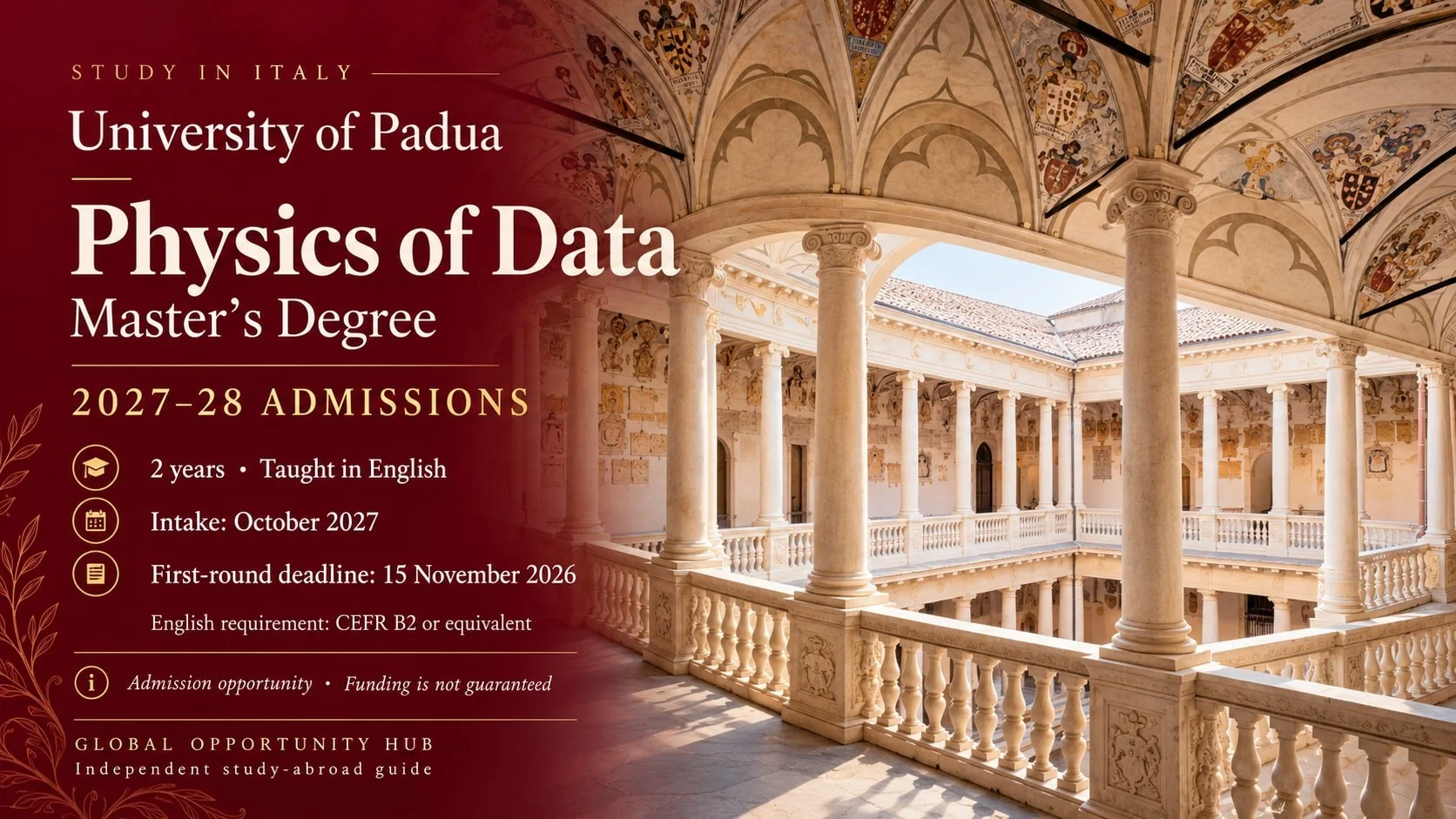
Study in Italy 2027: University of Padua Physics of Data Master’s Applications Open
Your physics degree can lead beyond the laboratory. If you enjoy using mathematics and computing to understand complex problems, an international postgraduate programme could help you develop that interest into deeper technical expertise. The University of Padua in Italy has opened its first international application round for the Master’s in Physics of Data, starting in October 2027. The first round deadline is 15 November 2026. The department welcomes applications from candidates who already hold an international bachelor’s degree or expect to receive it by July 2027, subject to the programme’s entry requirements. Official application announcement. For Nigerian and other African graduates considering this opportunity, the important questions go beyond getting an admission letter. You need to understand the academic preparation expected, how to document your experience and what the full study plan could cost. Information checked on 8 October 2026.
What you would study at Padua
Physics of Data is a two year, English taught master’s degree based in Padua. The programme combines advanced physics with mathematics, computing and methods for analysing large datasets. Its focus is particularly relevant to applicants who want to understand how scientific models and data analysis work together. The university identifies potential career settings including research institutions, technology companies, consulting and high tech industries. These are possible directions for graduates, not promises of employment.
Official programme overview.
The department also describes research oriented internship activities in research centres or private companies. Applicants should check the curriculum for their entry year before assuming a particular placement or module will be available.
Department’s course description.
This is a specialised academic programme. An interest in technology is useful, but your previous studies need to provide the necessary foundation.
The academic background you need
The programme requires a bachelor’s degree or equivalent involving at least three years of undergraduate study, with demonstrated skills in physics and mathematics. Country specific qualification and grade requirements also apply.
Programme entry requirements.
Before paying an application fee, review your transcript carefully. Identify the courses that demonstrate your preparation in physics, mathematics and quantitative work. If your degree title is engineering, mathematics or another related subject, do not assume that the title alone establishes eligibility. The content of your studies matters. Ask the programme’s academic office whether your background meets its requirements if the published guidance leaves you uncertain. Likewise, applicants with an HND or another qualification should check the university’s assessment rules rather than assume that every tertiary qualification is treated as equivalent to a bachelor’s degree.
Country based qualification guidance.
How to explain your academic strengths clearly Start by preparing a short private checklist connecting your previous studies to the programme. For your physics background, identify relevant modules, laboratory work or a final-year project. Explain what you investigated and your individual contribution. For mathematics, identify the methods you have actually used. A transcript provides grades, but a clear project description can show how you applied your knowledge. For computing and data analysis, describe a real task: the data you worked with, the tools you used, the difficulties you encountered and how you assessed your results. For example, an applicant who analysed laboratory measurements could explain how they handled noisy observations, compared models or checked uncertainty. That gives an academic reviewer more useful information than simply listing “data analysis” as a skill. These notes are preparation material, not an additional university requirement. Use them to make your CV and motivation letter more specific without exaggerating your experience. English requirements: what B2 means for your application The published language requirement is English at CEFR B2 or an accepted equivalent. Check the university’s list of accepted certificates, minimum scores and exemptions before booking a test or relying on an English-medium education letter. Do not assume that coming from an English-speaking African country automatically removes the evidence requirement. Official language guidance. The course is taught in English. Learning some Italian would still be a useful personal preparation step for everyday activities such as finding accommodation, shopping and communicating outside the university.
Tuition: understand the year and the fee category
The final 2027–28 charge was not confirmed in the fee information checked for this article. For reference, Padua’s 2026–27 page lists a EUR 2,990 annual contribution for its scientific-programme category for non-EU students whose households are outside Italy. It also lists a reduced category for applicants meeting specific country-based conditions. These are reference figures for the published year, not a personalised quotation or a confirmed 2027–28 bill. Regional tax and stamp duty arrangements should also be checked when calculating the total payable. Official student-fee information. Before committing, request clarification on three points:
- Which fee category applies to your citizenship and household circumstances?
- What will the total charge be for the 2027–28 academic year?
- Which additional charges or payments fall outside that figure? Keep tuition separate from accommodation, food, insurance, transport and travel costs. A manageable university fee does not automatically mean the entire move is affordable.
Is this a scholarship opportunity?
This announcement is an admission opportunity. An offer of a place does not itself mean that your tuition or living costs will be funded. Padua publishes information about scholarships, fee reductions and other support, but each scheme has its own conditions and deadlines. Check the relevant academic year carefully before including any award in your budget. University funding information. A sensible approach is to prepare two budgets: one without an award and another based on the exact terms of any funding you later receive. This helps you see whether accepting an offer depends on winning additional support. Documents to prepare before you apply The university’s general application checklist includes:
- A valid passport for applicants applying from outside the EU.
- Academic transcripts or marksheets.
- The relevant qualification certificate, if already obtained.
- A CV.
- A motivation letter.
- Required language evidence.
- Any additional documents requested for the programme. Documents should be uploaded as PDFs. Academic records must be official, and documents issued in languages other than English or Italian require the appropriate official translation. The programme-specific checklist in the application portal determines what you must submit. Official document checklist. There is a useful distinction between application and enrolment: the university says legalised documents are not required for the initial application, while further documentation may be required after admission. Follow the instructions for each stage instead of paying for every possible document service immediately.
How to apply through the official portal
Begin at the University of Padua application portal. Create one applicant account using an email address you regularly check. Select Physics of Data and confirm the academic year and applicant category shown in your application. Read the programme requirements and complete the checklist. Upload your documents, follow the application-fee instructions and review every section before submitting. The portal warns that submitted application details and attachments cannot simply be edited or replaced, although some additional documents may be added later. It also advises applicants against creating multiple accounts. Official portal instructions. Set yourself a submission target several days before 15 November. That gives you time to resolve a payment issue, obtain a clearer transcript or correct an incomplete document before the deadline. After submitting, monitor both the portal and your email, including the spam folder, for requests from the university. Writing a motivation letter that fits this programme Explain the connection between your previous education and the specific training you want. A useful structure is to discuss a scientific or technical problem you have worked on, what you learned from it and the skills you now want to develop. Then explain why this programme’s combination of physics and data methods fits that direction. Avoid making the letter mainly about wanting to leave your country or study somewhere prestigious. Those statements do little to explain your academic preparation. Your local experience can be valuable. A university project completed with limited equipment, for example, may still demonstrate careful experimental design or resourcefulness. Describe the work accurately and explain its limitations rather than overstating its impact. You should be able to discuss every project, tool and achievement you mention if the university asks for more information.
What happens after an admission offer?
Read the offer carefully for acceptance deadlines, payments and outstanding academic conditions. For applicants who need an Italian study visa, university admission and immigration approval are separate steps. Padua explains that the process involves pre-enrolment through Universitaly, and that an admission offer does not guarantee a visa. The relevant embassy or consulate makes that decision. Padua’s immigration guidance. Use the instructions applicable to your intake and country of residence. Keep a record of deadlines for accepting the offer, completing pre-enrolment, supplying final qualifications and arranging travel. Avoid making non refundable travel commitments merely because an admission email has arrived.
A final check before you apply
This opportunity deserves a closer look if:
- Your undergraduate studies provide a substantial foundation in physics and mathematics.
- You want a specialised master’s combining scientific reasoning and data methods.
- You can provide the required academic and language evidence.
- You will meet the qualification-completion deadline.
- You have a realistic plan for tuition and living expenses.
- You can prepare a complete application before the first-round deadline. A thoughtful application gives the university a clearer basis for assessing your suitability. It cannot guarantee admission, but it helps ensure your real strengths are visible.
Apply independently or contact us for support
You can complete your application directly through the university’s official portal using the “Apply here” button. If you are unsure how your qualifications match the requirements, which documents to prepare or how to organise the process, Global Opportunity Hub, through Vixx Integrated Services, can help you work through those questions. Use the “Let us apply for you” button to discuss the support you need. You should retain access to your account, review your documents and approve all information before submission. Our support is optional and independent of the University of Padua. The university decides admission, scholarship providers decide funding, and the relevant authorities decide visa applications.
Verified by Global Education Experts
This admission route has been manually reviewed for accuracy. A Vixx Integrated Services initiative.
Explore Alternative Routes
Join the VIP Alert List
Do not miss the next intake window. Get high-acceptance study routes and direct admission guides sent directly to your phone.
Submitted Successfully!
Our staff will reach out to you on WhatsApp shortly.